

How to discover soccer odds generated by delayed results and use them to make your betting analysis more effective.
During the championship, on more than one occasion, each team, by definition, has two types of “delayed” results. For example, if they lost their last match, they will have a delay in their expected win and draw.
This objective, organic, and perpetual aspect of championships, so simple and banal that it makes you think right now of a nice “… and thank goodness…” is the starting point of the analysis on the Natural Predictions platform.
What seems so obvious to you has potential that most bettors are unaware of, don’t explore in depth, or don’t exploit correctly.
For us, it’s our daily bread. Gluten-free. Without complications, without taking anything for granted, and with the awareness and determination to discover data, know how to interpret it, recognize opportunities, avoid unnecessary risks, and monitor trends.
To do this, we’ve equipped the platform with several proprietary statistics. One of the key ones is the “Frequencies” statistic. We’ve discussed this on other occasions, but today we’re taking a closer look, specifically at the odds that arise based on the type of expected delay.
In practice: Team X has been waiting for a draw for 5 games. What odds have they generated so far in the same situation? What odds for both of the two current delays? What odds for home, away, or overall? And what about the opposing team?
The wonder of a mere objective fact, seemingly simple and banal, which opens up a scenario, a world to be discovered and, above all, exploited.
“Thank God.” Actually, no, really.
For those who wish to at least, I repeat at least, take into consideration (if not as the first trigger) the trend of delays, which we have called Natural Predictions, because they are spontaneous and recurring data.
The platform offers data on the odds generated by delayed results at both the team and league levels. In both cases, they are already factored into the reality of the match being analyzed, to facilitate match analysis and comparison.
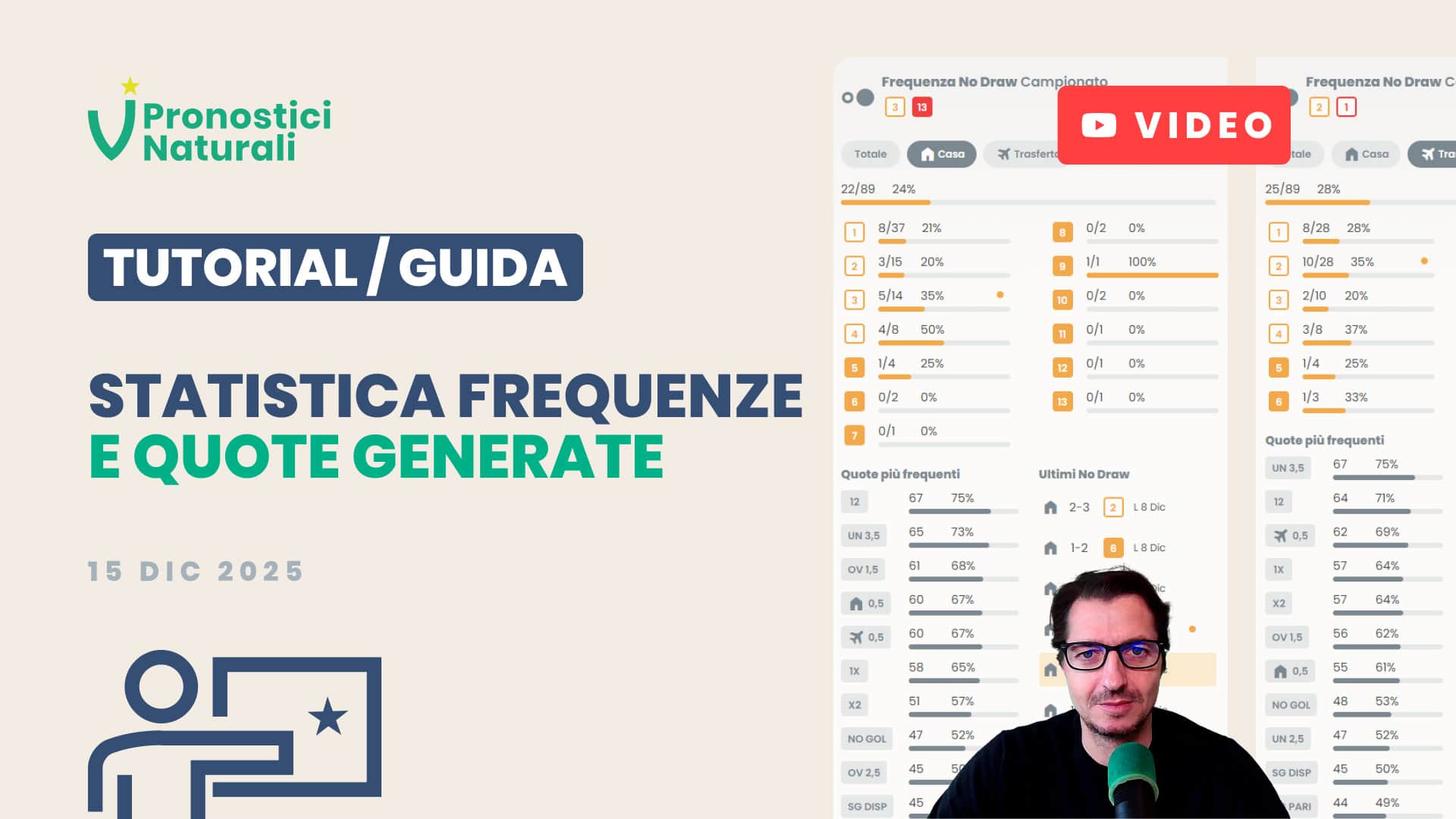
In the video, you can see some analyses of recent examples. The odds considered are the 18 integrated into the platform , among the most common and classic.
Observing and monitoring the resulting odds versus the expected delay is one of the key statistics to watch with great interest. But be careful: don’t look for the exact and consistent rule. The rule is that there are no rules, like in the famous movie.
Because the final selection of a prediction is the result of a mix of analysis and evaluation. Predicting football remains a mystery, and that’s also its beauty and its opportunity. Otherwise, football betting odds would be incredibly low and boring, like in so many other sports.
In our soccer predictions, we try to gather as many clues, as many facts, and as many objective data as possible to reach a decision.
In our case, they take the form of suggestions , highlighted in green every day, for practically all matches except those that just smell of risk. The ones where whatever you choose remains a forced and useless solution.
However, for practically all matches, there are suggestions from 1 to 3 maximum.
In the Frequency statistics, in addition to specific data on dry delays (the entire list of delays considered, with the number of instances and percentage of occurrence), there is also a sorted list of the most frequently issued quotas, how many, and the percentage with respect to the type of delay considered. This includes data for home, away, or as a total aggregate.
Each lag with its data, both individually and as a combo of double expected lags, i.e., the team’s complete situation, as mentioned at the beginning of the article. This is probably the most important because it shows the data for both cases.
An additional analysis opportunity is offered when a match pits two teams with the same delay pair. For example, NoWin + NoDraw vs. NoWin + NoDraw.
In these cases, if you haven’t already done so, it’s also very useful to look at your two delay types, NoWin and NoDraw, and then, as a NoWin + NoDraw combo, also as a match total. The reason is that we have a clear view of the specific performance of both teams combined in the same trend type and can therefore make more precise assessments of the generated odds.
Similarly, statistics are available as an aggregate for an entire championship to date. I repeat, there’s no precise rule; what I always recommend is to have fun analyzing, discovering, finding patterns, and comparing the teams’ data in the match and in relation to the championship total.
Clearly in the list of odds above, among the most widespread, there will be low coverage odds , it also depends on what you like to consider, what type of game you have. If you like goals, odd and even sum goals, home or away goals, double chances.
Mind you, we’ve already demonstrated this many times, including recently with the two example betslips created with coverage odds. Even a goal scored, an over 1.5 is a viaticum for an excellent, optimized and prudent play.
At first glance, therefore, you can observe, starting from the most conservative odds and downwards, what, for example, might be the right balance between odds value and frequency, obviously also considering other aspects relating to the match.
The data you find in this league-level statistic are an objective and realistic reflection of the trend of the odds released compared to the expected delay.
Sometimes they may seem strange, even surprising, but that’s what they are, there’s no escaping it. They’re objective data, not interpretations or assessments of the platform. So, while they obviously won’t always follow the same trend, it’s also true that it’s better to follow a trend than to be a contrarian based on a biased stance.
It’s certainly a good and fair thing to make a broad and open-minded assessment, looking at a micro cycle, for example, in the list of the last 15 matches compared to a share of the championship total.
Example: I would like to bet on the Goal odds, which have been available at 60% in the league, and furthermore, in the last 15 matches I see that the last 4 are No Goals and that there are only 5. Perfect, this is a case with favorable characteristics.
The important thing to keep in mind is that the odds list on the left considers data from the entire championship, while the results list only considers the last 15 matches.
Try observing and monitoring the Frequency statistics data; you’ll often find truly interesting patterns that unlock a good portion of useful analysis. You also need to be a little creative, exploring the different data points.